Detail Parts for Model Engineer's Laser Tram Loco
 A set of detail parts created by myself to spruce up the Model Engineer's Laser Tram loco kit (see related content)
A set of detail parts created by myself to spruce up the Model Engineer's Laser Tram loco kit (see related content)
My take on a SR milk tank wagon at 10mm scale.
Spacers to help lay double track.
Designed for Cliff Barker track, gauge widened (45.5 mm gauge)
These were designed for Cliff Barker track. There are two versions, 8mm wide and 9.4mm wide, and they give 1,2,3 or 4 mm superelevation. Best to glue or solvent weld them onto the sleeper bases - every three or four sleepers is fine.
This is the model for a SECR-designed and SECR/SR-built van to Diagram 1426. Several of these vans were rebuilt with ventilated sides for use on London-Dover-Folkestone fruit traffic, subsequently labelled as Diagram 1427. This van survived into BR revenue-earning service, and several becoming departmental vans in the black livery.
There were both unfitted and vacuum fitted versions, and a brake cylinder has been provided for the latter. You will need to source vacuum pipes yourself, however!
Please note a few caveats:
This is a model of the early Stockton and Darlington railway Chaldron wagon. It is based on the images of a wagon in the The National Railway Museum at Shildon catalogue number: 1979-7005
Simple wagon wheels to G1MRA Fine and Standard profiles
The bore is sized for 2.9mm for reaming 3mm or 1/8" as appropriate. I have used this with success on 3mm ground steel axles into 3x8x3mm ball-race bearings.
I have included a 40mm B2B Gauge, a 42mm B2B is available on the G1MRA 75th Anniversary Brake Van model.
This describes my 10mm version of Peter Davis' brilliant model, including my construction notes and STL files for the new parts made. This is now a revised version with additional new parts.
Enlarged version of my G1 Sentinel.
The largest piece is the body at 224.1mm long. My Elegoo Neptune pro printer has a table that will accommodate this.
May 24 Source for Delrin sprockets and chain in UK, suggested by Robert SP (thank you Robert):
KARLGARIN MODELS January 2019
Warren Farm, Little Baddow, Chelmsford, Essex CM3 4TQ
Tel: (0)1245 226110 E-mail: skippy@karlgarin.com
9/Feb/24 Updated: G3-22.0 Handrail 1.stl Shortening height form 5mm to 3mm.
The parts are called 'Active' because that was the locomotives original name. Michael Bailey's report is here: https://www.railwaymuseum.org.uk/sites/default/files/2023-10/Pages%20from%20LOCOMOTION%20report%20part%201.pdf
The files contained here are experimental and have been made available for development purposes only. There is not yet sufficient to make a complete locomotive.
This is still in development - if you find a problem or have suggestions for improvement please send feedback.
The initial inspiration was to create a representation of a coal load or ballast track bed.
The code is capable of generating a simulation of a full coal load, part used coal load or wagon fill, coal pile, flat spread/ballast, straight track base, radius track base.
The track bases can be used to merge with track models before printing or can have a slot cut for using loose track.
Here is some openSCAD code that can be used to create handrails and stanchions.
The code is still underdevelopment.
To use you can either create and 3d model for a single stanchion or the code can be used to create a single modle multiple stanchions and handrails.
Currently limited to a single style of stanchion and cylindrical handrails.
The first image shows what is generated by the default openSCAD code.
No STLs are currently provided as these would depend on usage.
Sentinel Y3 Locomotive.
May 24 Source for Delrin sprockets and chain in UK, suggested by Robert SP (thank you Robert):
KARLGARIN MODELS January 2019
Warren Farm, Little Baddow, Chelmsford, Essex CM3 4TQ
Tel: (0)1245 226110 E-mail: skippy@karlgarin.com
22/Feb/24 I found Flats should be filed on the Jack Shaft and the Axle Shafts where the Sprocket set screws seat.
A small collet chuck for 1mm, 1.5mm, and 2mm drill bits that makes it just a little easier to "twizzle" the bit between the fingers.
Many G1 modellers who have their own rolling stock use the 'Really Useful' brand of plastic boxes, particularly the 22l version for transporting and storing G1 coaches.
A problem with these boxes is that if stacked and then slid over one another the standard blue polypropylene lid clips can come dislodged. If one is not careful one can find that trying to lift 2 boxes just results in lifting one and a lid.
The object of this clip design is to provide a more secure clip that does not project above the box top and prevents dislodging.
Tref’s G1MRA Anniversary Brake Van Project was a van to celebrate the 75th Anniversary of G1MRA, with a contribution from the 3d Printing Circle.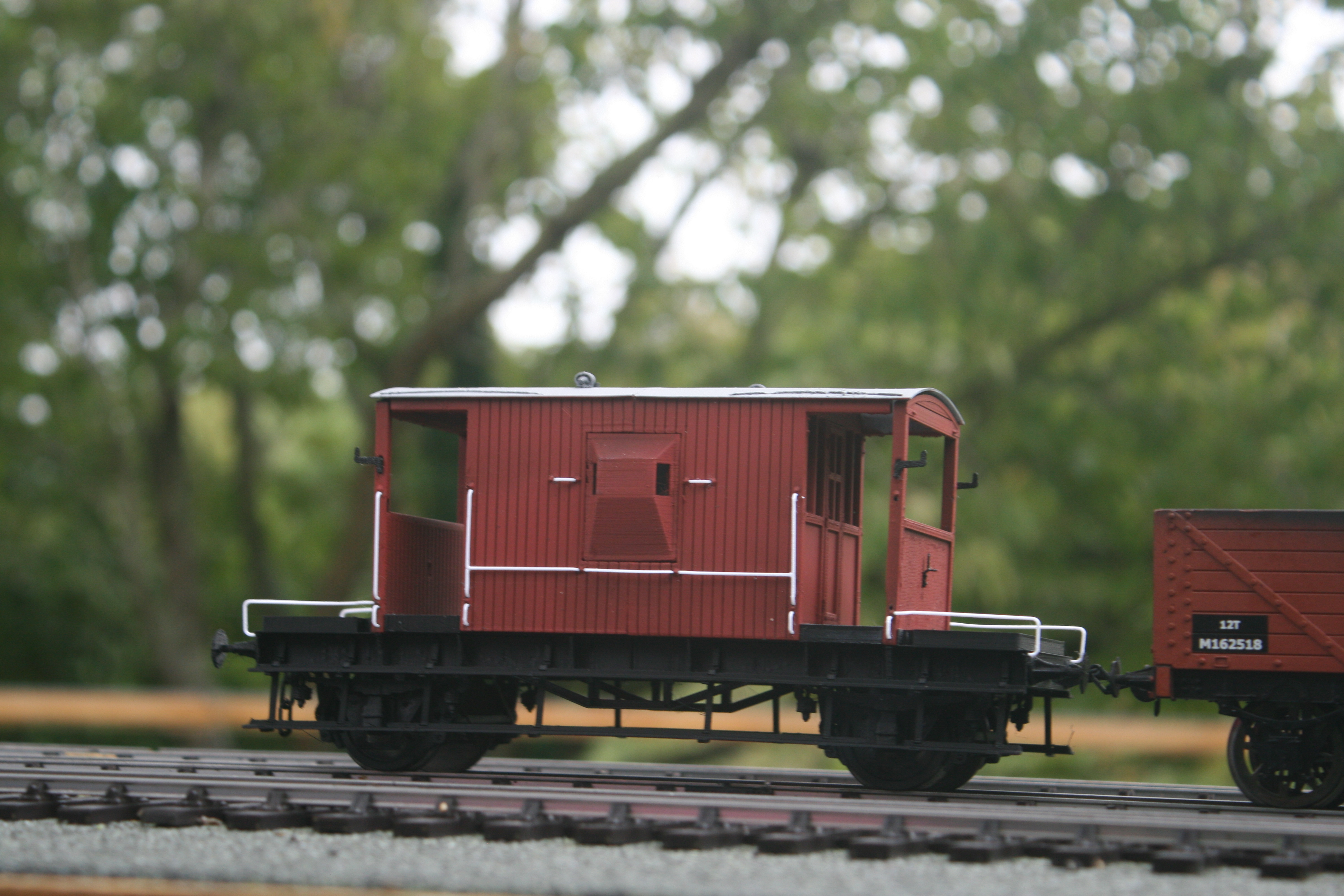
It is intended to be easily printed and assembled on the majority of FDM printers.
The initial publication of this coach is an attempt to make a simple model for the "Christmas tree" project.
Some discussion is needed to simplify the design to make it easy to print. Currently the break gear on the ends of the coach are rather fragile and the body, if printed on a resin printer probably needs dividing into two for most printers.
The smaller components were designed for resin printing. The body, when resin printer is in two parts.
S1 - 4 compartment second later converted to third class.
4 wheels
25' x 8' - 18' wheelbase
Model of the SER Clapboard Waiting Shelter based on the drawing by Brian Hart in the Elham Valley Railway book.
10mm scale. Slots provide for 1mm clear plastic sheet to be used for window glazing.
Wooden underframe five plank wagon produced in huge numbers during the 1920s. Lasted into the 1950s. This model was originally on the Groups.IO site but got lost in the move. I have taken the opportunity to improve some details. It now incorporates a barrow ramp at the top of the door, and the brake gear rack has been considerably narrowed to come closer to the prototype. The W irons are now less of a tight fit.
Freelance model of a Storkleg locomotive steam toy of about 1900.
Tool developed for bending handrails for the BR 20t Brake Van Project - but obviously its use extends beyond that...
Designed for and tested on 0.8mm diameter stainless steel mig welding wire, that is otherwise rather difficult to get a neat, tight, bend in.
It utilises a modified M5 Hex head bolt, with a plain shank element of at least 20mm, cut and slotted at 1 end 5mm deep - see the .STL, just don't expect a 3d printed version to work! It uses a second bolt (or second part of the first one).
Sectional track each printed as one piece.
After the second world war 10 War Department Class 08's were purchased by the Nederlandse Spoorwegen in 1946. Because they were not equiped with Westinghouse brakes, they could only be used for shunting services (500 series). The series 600 and 700 were fitted with the required brakes to operate on the main lines. The exterior of all the series is almost identical.
Stanier's first long wheelbase guards van, built from 1933. Very much an alpha release as I have not managed to put together a completely satisfactory model myself. Please feed back any issues found.
Chassis and gearbox for 1910 Greenly designed Great Northern Gauge 2 0-4-0 Saddle Tank. This model was originally electric when made in 1910 but came to me without chassis or mechanism. The outline follows Greenly's design and the mechanism is a modern 385 motor driving through my standard bevel wheel gearbox. Power is supplied by 2x 26650 Lipos and running time is several hours (at least).
This is some openSCAD code and stls for an L shaped corner clamp. Given the need I will try to enhance this code further at some time.
Hopefully this will prove usefull to someone. Does not need supports to print.
The first parameter "type" is there for future additions of different clamps.