Greenly Locomotive Box
This is a 3D printed travel case for the G1MRA Greenly starter locomotive.
This is a 3D printed travel case for the G1MRA Greenly starter locomotive.
A more or less there version of the short lived Class 17 Clayton. As the loco is more or less a mirror image, print 2 of most of the parts.
Bogies are designed around the Fosworks units with top hat bearings.
Handrails etc. 1mm brass wire.
There is adequate room inside for directional lights (3mm bicolour), headcode lights (use Fox transfers), and sound.
I would construct the two bonnet sections using self tapping screws, before joining the two halves together.
LNER designed BK container to Diagram 31. 200 containers were built to this design.
In LNER days, these containers were painted Oxford Blue with yellow lettering in a "Zig-Zag" colour scheme promoting furniture removal.
These would be seen on conflats, Lowfits*, 3 plank wagons and high sided open wagons. High sided wagons were sometimes used to prevent the doors being opened in transit and pilfering of the load.
*BR prohibited use of Lowfits for containers but photos show them being used in LNER days
LNER designed BD container to Diagram 29. 300 containers were built to this design.
In LNER days, these containers were painted red oxide with yellow lettering.
These would be seen on conflats, Lowfits*, 3 plank wagons and high sided open wagons. High sided wagons were sometimes used to prevent the doors being opened in transit and pilfering of the load.
*BR prohibited use of Lowfits for containers but photos show them being used in LNER days
This model is designed from drawings published in "Historic Carriage Drawings, Vol 3, Non passenger coaching stock" by Peter Tatlow
It's the 'Blue Book' (ISBN 1-8998 16-09-7). Also consulted were, photographs available on-line from many sources supplemented by viewing vans where I could.
These coal loads have been generated using the coal load generator in OpenSCAD loaded by Les Coombes, many thanks to him for making it available. I have used this to create some loads of the right size for the 1923 RCH mineral wagon, and also created a base to set the coal load at a suitable height. As the coal load generator is quite slow to run (on my laptop anyway) these models may help save time for others.
I've done some work using openSCAD to replicate the gearbox used on the Greenly starter loco.
The initial brief I gave myself is to create a clone of the gearbox, not necessarily identical but close enough that it can be used as a replacement in the loco.
The aim was to allow myself to experiment with different gear profiles and ratios, primarily the use of herringbone gears rather than the straight spur gears used in the original.
I've created a 3D printable G1 track for indoor shelf type layout. With 1800mm radius curves to be suitable for 4-wheel wagons and small locomotives.
27 June 2026, I replaced the Throw Bar 71, with Throw Bar 71.1.
1 July 2026, I replaced the Throw Bar 71.1, with Throw Bar 71.2.
This section contains some add-ons I've designed for the G1 MRA Greenly starter loco.
Currently this consists of:
Here are some STLs representing a GWR style buffer stop. Currently two have been uploaded, they are identical other than the one having wooden type buffer beam and the other representing an rail beam.
I have printed these upright in one piece in PETG and other than the support being a bit tricky to remove from between the guard rails they printed fine.
Like many buffer stops there seem to have been many variations on a theme.
Following on form other coal loads, these are coal loads for fitting in Tref's BR 16 ton clip-together mineral wagons.
This is just the coal surface designed so that you can put some sort of spacer underneath to raise them to the desired height. This minimises the print time (Each took about 6 hours on my Qidi Q1 Pro).
As with other coal loads, printed in black filament such as PETG looks reasonably realistic without painting
This is a coal load for fitting in the Accucraft wooden RCH mineral wagons. It is sized to fit into these wagons, which have slightly thick sides. The base has angled ends to make it easy to remove the coal load.
Coal load 1 represented is in large lumps such as best quality steam coal- other grades of coal may be added later.
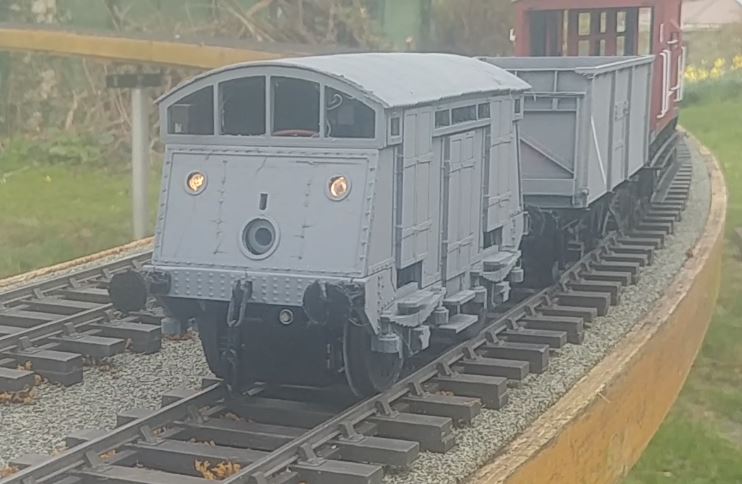
It doesn't look like it could ever be real... Copyright concerns mean I am not posting a picture of the prototype, but it really did exist!
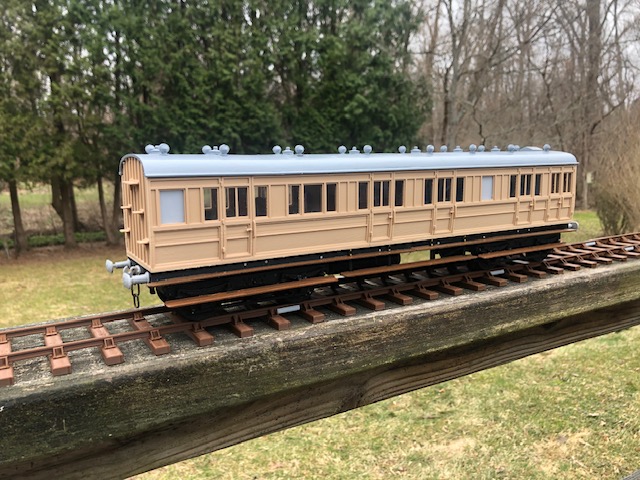
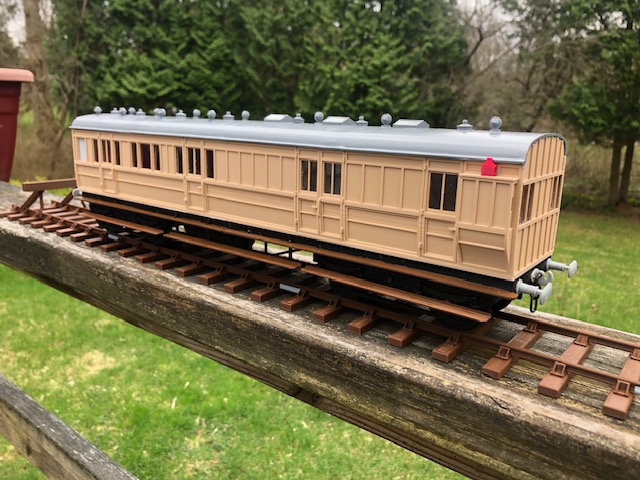
Print and assembly of GNR 45' Bogie Coach Dia 129 and 3rd Brake D277.
17 April 26 Added; Chapters for D277 3rd Brake. 7 and 8. also updated chapter 4.
LNER "Lowfit" wagon. 1378 were built between 1936 and 1938. Used for transporting road vehicles and machinery. Photo evidence shows them having been used for containers in LNER days, but BR added lettering stating "not to be loaded with containers".
Similar wagons were built by BR with steel underframes and LMS or Morton brake gear.
Designed for 1/32 scale.
This model is designed for resin printing with some elements laser cut in 0.030" steel.
This Brake coach body assembly is the third of three styles that use the common underframe uploaded 27/05/2025.
Glazing slots are provided for fitting glazing film (typically 0.25mm laminating pouches).
The coach roof is held to the body by printed retainers holding captive m3 nuts and countersunk screws.
An isometric assembly drawing and item list is provided.
The body assemblies are fastened to the underframe with 6 M3x16 countersunk screws.
This 1st class coach body assembly is the second of three styles that use the common underframe uploaded 27/05/2025.
Glazing slots are provided for fitting glazing film (typically 0.25mm laminating pouches).
The coach roof is held to the body by printed retainers holding captive m3 nuts and countersunk screws.
An isometric assembly drawing and item list is provided.
The body assemblies are fastened to the underframe with 6 M3x16 countersunk screws.
This 3rd class coach body assembly is the first of three styles that use the common underframe uploaded 27/05/2025.
Glazing slots are provided for fitting glazing film (typically 0.25mm laminating pouches).
The coach roof is held to the body by printed retainers holding captive m3 nuts and countersunk screws.
An isometric assembly drawing and item list is provided.
The body assemblies are fastened to the underframe with 6 M3x16 countersunk screws.
This underframe was designed as a common item for a set of three GNR 4 wheel coaches.
The coaches comprising 1st class and 3rd class saloons and a 3rd class saloon/brake.
The inspiration for these models was a set of coaches produced in OO gauge by Hornby. These coaches are not claimed to be highly accurate to any particular prototype. The object was to produce low cost models that look in keeping with the Aster Stirling Single 1/32nd scale live steam locomotive.
The underframe is my first release. The three body shells will be released to follow during 2025.
This design replaces the previous version. There are also additional files applying to the underframe and brake details etc. The previous design will be removed from the files.
The files also include a drawing of the vehicle and a parts list for the model. Note the additional, non-3d printed requirements.
This is a track inspection tool designed to find bumps & hollows. It comprises a flexible strip that can be placed on a rail, with three guides to help the placement.
On a bump there will be gaps visible at each end of the tool/rail boundary & the tool can rock on the bump.
On a hollow there will be a gap visible in the middle of the tool/rail boundary.
This is a variant body for the 16T Mineral Wagon - Clip-together created by Tref Waldorf. I have use the Prusa sliccer to emboss the sides with G 1 M R A & also a panel that reads "Return to Surrey Oval". I have posted the .3mf file so you can use the Prusa slicer to edit the words if you wish to change the return destination.
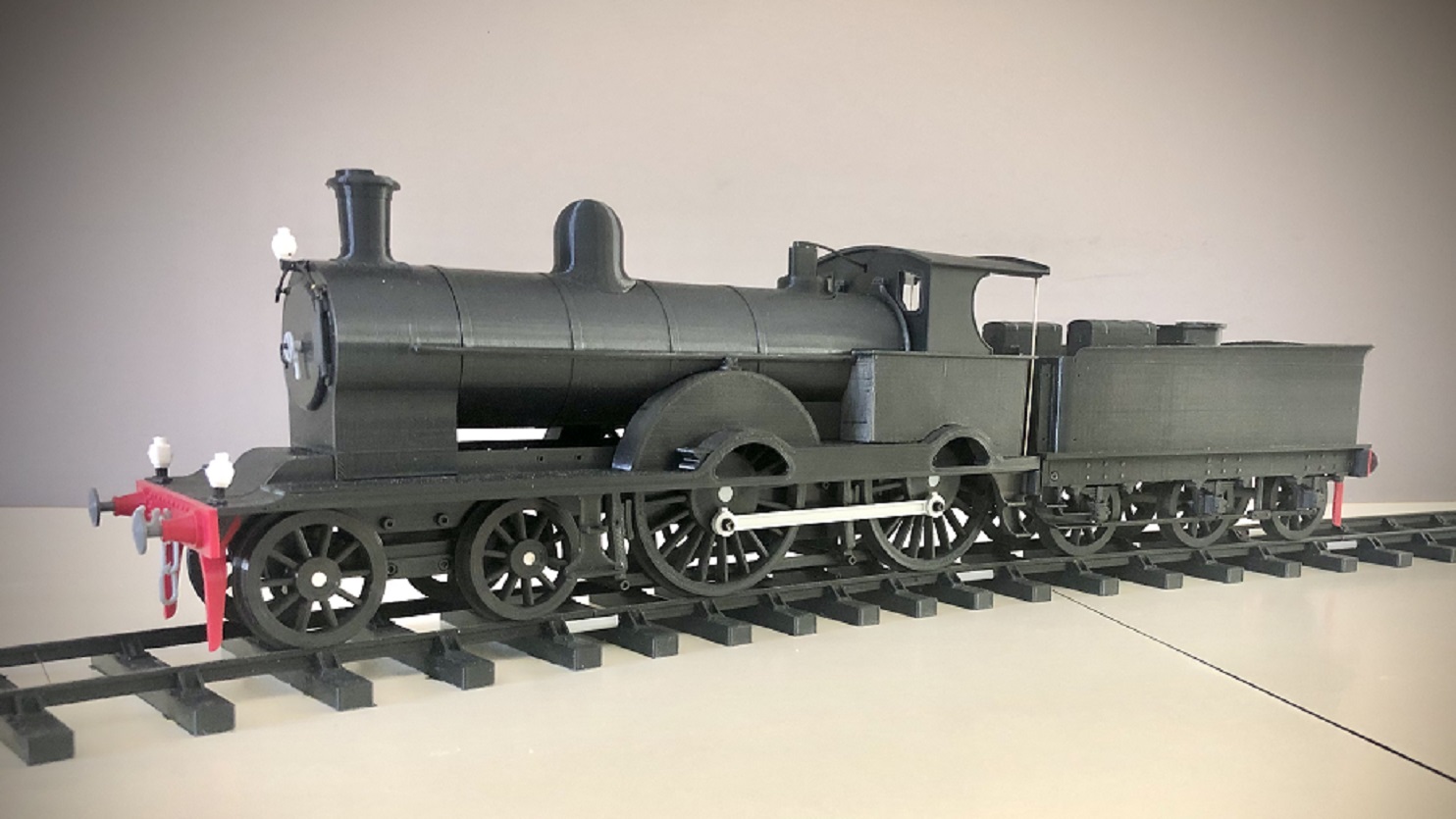
My Merlin!
Mostly to 10mm scale. Printed on an Elegoo Neptune 3 Pro, with PLA plus filament. Two N-20 motors power the drivers, controlled from the tender by batteries and a small DC motor controller.
This is openSCAD code that can be used to generate a variety of various railway wheels.
Included are some images and sample wheel stls. All the samples are 1/32 fine scale renders. All have been rendered for fine details ($fn=200) other than the Mansell wheel which was rendered with $fn=100 to keep the size of the stl reasonable.
The code can also produce standard wheels in both 1/32 and 10mm scales. Also supported are 3.5in and O gauge by selected the correct "sf" value in the code. The code could be extended to support other scales.
Commercial point levers of the 'lever in diagonal slot' pattern can be self built with various throws as required.
These printed versions (once designed) offer a faster to make alternative and avoid the separate lever rod that often becomes detached in commercial offerings.
Three alternative throws (2mm, 4mm and 8mm) are provided. Others may be added later as reqd. Commercial levers are often 6mm throw.
Suggested print parameters.
Material: PETG
Infill density: 100%
Layer height: 0.1mm
Nozzle dia: 0.4mm
A version of the ubiquitous 16T Mineral Wagon designed to be easy and fast to print and assemble. Almost as easy to disassemble, in order to replace any parts. Can be run with the wheels and axles as they are, or fitted with R144ZZ Bearings at any stage, without any further parts required.
Both Coarse and Fine G1MRA standard wheels and axles included.
Proven out on a Prusa Mk3 i3, in PETG
Here I have enlarged my 08 shunter to Gauge 3, 2.5-inch gauge. I did this some time ago, now final finishing a few things and tidying up the files.
To save space I've added zip files.
Peter D. August 5, 2024
Update July 17, 2025.
As for the motor and gear boxes, let me suggest 600 rpm as a better choice. The 300 rpm will give a top scale speed of 20 mph. The 600rpm should do this at half throttle and allow for battery decay and loads.
This hook has been added following recent requests for a 3d printable one.
Some hooks are contained within various wagon models but this one was designed to replace a Northern Finescale plastic moulded hook.
No doubt laser cut steel hooks are much stronger but this hook when printed in PETG has been found strong enough for most applications.
The examples shown are printed in silver PETG (I would normally use black). Infill was 100%, layer height 0.1mm, a brim was included to aid bed adhesion.